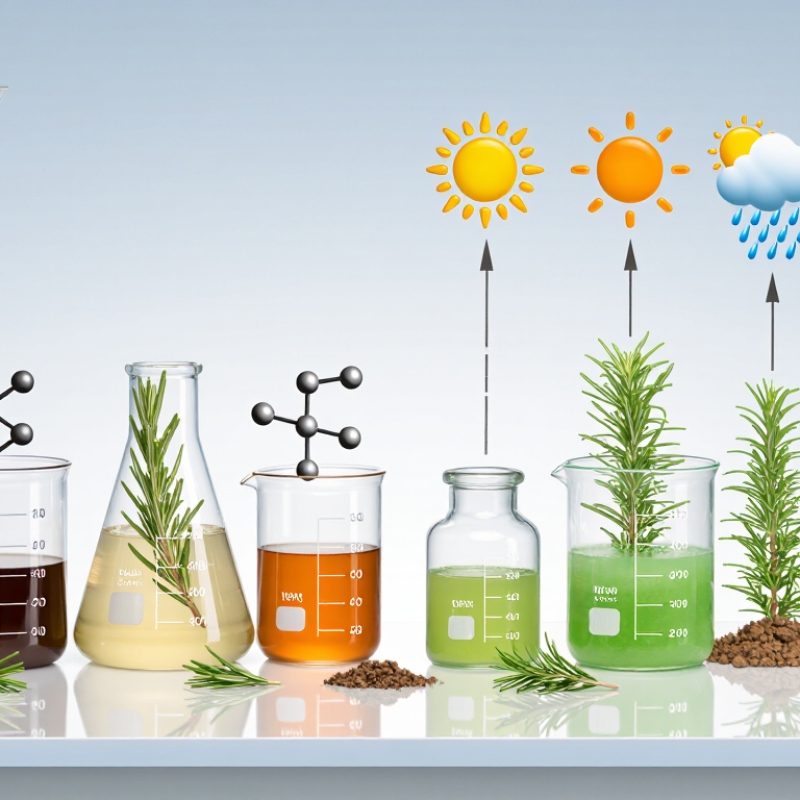
Why do extracts have different concentrations? The answer begins with the plant, not the label. A rosemary extract may contain more marker compounds than a batch harvested after heavy rain. Soil, climate, plant maturity, storage, and processing all change the raw material. The World Health Organization’s Good Agricultural and Collection Practices guidelines identify these variables as critical quality factors. The European Medicines Agency also evaluates herbal products through identity, purity, assay, and stability requirements. These controls explain why two extracts can look identical but perform differently.
Concentration can also describe different measurements. The drug-extract ratio compares starting plant material with the final extract. It does not automatically prove stronger activity. Solvent choice matters too. Water, ethanol, glycerin, and supercritical carbon dioxide remove different compound groups. A standardized extract adjusts a selected marker compound, while a non-standardized extract may simply reflect the harvested batch. USP General Chapter <565>, Botanical Extracts, emphasizes appropriate testing and characterization. Laboratory reports commonly examine moisture, microbial limits, heavy metals, pesticides, and marker compounds. Practical detail matters: a powder with 5% moisture is not equivalent to a sticky extract with 20% moisture. The weight includes different amounts of actual plant solids.
Some explanations remain imperfect. “Higher concentration” can sound like “better,” but that is not always true. A stronger extract may contain less of another useful compound. Readers should compare the extraction solvent, drug-extract ratio, marker assay, and certificate of analysis. Those details make concentration meaningful. They also reveal where a product description needs more evidence.
What Concentration Means in an Extract
Why Do Extracts Have Different Concentrations?
What Concentration Means in an Extract
Concentration describes how much extract material exists in a measured amount of liquid or powder. It is not automatically a measure of quality or effectiveness. A liquid may show milligrams per milliliter, while a powder may use a percentage. These units describe different quantities. They should not be compared without careful conversion.
For example, an extract labeled 10% contains a stated amount of target material within the total product weight. A liquid containing 50 milligrams per milliliter gives a volume-based measurement. The solvent also matters. Water, alcohol, glycerin, and oil can hold different amounts of extracted compounds. Processing temperature, plant condition, moisture, and storage time can change the final concentration. Small details matter.
In practical quality checks, I look for the batch number, testing method, and certificate of analysis. The testing method can influence the reported result. One laboratory may measure total compounds, while another measures only selected compounds. That difference can create confusing labels. I still find concentration easy to misunderstand. A higher number may simply mean less solvent, not a better extract. A careful comparison needs the same unit, the same target compound, and similar testing conditions. Even then, natural materials vary from batch to batch. That uncertainty deserves honest attention.
Why Do Extracts Have Different Concentrations?
What Concentration Means in an Extract
Extract concentration can be expressed as raw-material equivalent per millilitre of finished liquid.
The chart assumes 100 g of starting botanical material and compares different final solvent volumes.
A smaller solvent volume produces a higher calculated concentration.
Calculation: 100 g × 1,000 mg/g ÷ final extract volume. These values describe raw-material equivalence,
not the concentration of a specific active compound. Actual potency also depends on extraction yield,
solubility, processing conditions, and analytical testing.
How Raw Materials Affect Extract Strength
Why Do Extracts Have Different Concentrations?
How Raw Materials Affect Extract Strength
Extract strength begins with the raw material, not the label on the finished bottle. A fresh leaf may contain more water than a dried leaf, changing the measured concentration. Harvest timing matters too. Young plants often have different compound levels than mature plants.
The plant part also makes a clear difference. Roots, seeds, flowers, and leaves can contain separate chemical profiles. Even two batches of the same plant may vary because of soil, rainfall, storage temperature, or drying speed. I have seen dried material lose its aroma after poor storage. That change can signal deeper quality problems.
Moisture is easy to overlook. A sample with excess water may produce less extractable material by weight. Grinding size, extraction temperature, and contact time also affect the final result. However, a darker extract is not automatically a stronger one. Color can come from harmless pigments or natural oxidation.
Reliable producers test incoming materials before processing. They may check identity, moisture, microbial quality, and key active compounds. Laboratory results help, but they are not perfect. Testing one small sample cannot represent every piece of a large batch. This is where careful sampling and traceable records become essential. I still think “higher concentration” can sound too simple when raw material quality remains uncertain.
How Extraction Methods Change Concentration
Why Do Extracts Have Different Concentrations?
Extraction methods change concentration because they remove different compounds at different speeds.
Water pulls out sugars, minerals, and many polar compounds.
Ethanol can dissolve more oils, resins, and moderately polar constituents.
Heat speeds movement through plant cells, but excessive heat may damage fragile compounds.
A 2023 review in Molecules reported that ultrasound-assisted extraction often reduced processing time by
30–60% compared with conventional heating.
Faster is not always better.
The solvent ratio matters too. Using
1:5
plant material to solvent usually produces a different extract from a
1:20
ratio. Fewer solvents can create a thicker extract, while more solvent may improve compound recovery.
The WHO Quality Control Methods for Herbal Materials stresses testing identity, purity, contaminants, and marker compounds, not relying on appearance alone.
Drying creates another shift. Removing water increases measured solids, but it does not automatically increase useful activity.
This comparison is imperfect.
In practice, extraction temperature, particle size, mixing, filtration, and evaporation all influence the final concentration.
A 2022 review in Frontiers in Pharmacology noted that standardized extracts require controlled markers and validated analytical methods.
Two extracts may look equally dark yet contain very different chemical profiles.
Small process changes matter.
Testing should follow the finished batch, not assumptions from the raw material.
Why Solvents and Extraction Ratios Matter
Why Do Extracts Have Different Concentrations?
Why Solvents and Extraction Ratios Matter
An extract’s concentration begins with the solvent. Water pulls out sugars, minerals, and some polar plant compounds. Alcohol can dissolve a wider range of constituents. Oil favors fat-soluble components. The solvent does not simply “make” an extract stronger. It selects what leaves the raw material. Ratios change everything.
In practical work, I measure both the plant material and the solvent by weight. A 1:5 ratio means one part material meets five parts solvent. A 1:10 ratio usually produces a thinner mixture, but it may improve contact and movement through the material. Temperature, grinding size, soaking time, and filtration also affect the final result. Small changes matter.
A concentrated extract can contain more target compounds per milliliter, yet concentration alone does not prove quality. Reliable testing should identify marker compounds and check for unwanted residues. I have seen thick extracts perform inconsistently when the raw material varied between batches. That detail is easy to overlook. The label may show a ratio, but it may not explain whether the material was fresh, dried, or previously extracted. Clear records make comparisons more honest. Without them, “stronger” remains an assumption rather than a measured fact.
Why Do Extracts Have Different Concentrations? - Why Solvents and Extraction Ratios Matter
Comparison of common solvent systems and solid-to-liquid ratios using a standardized 100 g raw-material batch.
Calculated dissolved-solids concentrations assume that 8 g of extractable solids are recovered from each 100 g raw-material batch. Actual extraction yield varies with material, particle size, temperature, time, and processing method.
| Solvent system |
Main compound groups commonly targeted |
Solid : liquid ratio
(g : mL) |
Solvent volume for
100 g material |
Calculated solids concentration
(g per 100 mL) |
Why the concentration changes |
| Water |
Sugars, salts, proteins, polysaccharides, and other strongly water-soluble compounds |
1 : 5 |
500 mL |
1.6 |
A larger solvent volume distributes the same recovered solids through more liquid, producing a more dilute extract. |
| Water |
Sugars, salts, proteins, polysaccharides, and other strongly water-soluble compounds |
1 : 2 |
200 mL |
4.0 |
Using less solvent increases the amount of dissolved material per unit volume, provided mixing and wetting remain adequate. |
| 70% ethanol / 30% water |
Many polyphenols, flavonoids, tannins, and moderately polar plant constituents |
1 : 5 |
500 mL |
1.6 |
The mixed solvent can dissolve a different chemical profile from water alone, even when the extraction volume is identical. |
| 70% ethanol / 30% water |
Many polyphenols, flavonoids, tannins, and moderately polar plant constituents |
1 : 2 |
200 mL |
4.0 |
The same solvent strength becomes more concentrated when the solid-to-liquid ratio is reduced from 1:5 to 1:2. |
| 50% ethanol / 50% water |
A broad range of polar and moderately polar constituents |
1 : 3 |
300 mL |
2.67 |
Changing the ethanol-to-water balance changes solvent polarity and therefore changes which compounds enter the extract. |
| Food-grade glycerol / water |
Polar compounds and water-soluble constituents; glycerol also increases viscosity |
1 : 3 |
300 mL |
2.67 |
Viscosity can slow filtration and mass transfer, so the measured concentration may differ if extraction time or mixing is insufficient. |
| Food-grade oil |
Lipids, lipid-soluble pigments, waxes, and other non-polar constituents |
1 : 5 |
500 mL |
1.6 |
Oil selectively dissolves non-polar material; its higher viscosity can also affect mixing, filtration, and the apparent final concentration. |
Key relationship:
Extract concentration is influenced by both solvent selectivity and solvent volume. For the same recovered mass, the approximate concentration can be calculated as:
Concentration (g/100 mL) = recovered extract solids (g) ÷ solvent volume (mL) × 100
How Extract Concentration Is Measured and Standardized
Extract concentration is not measured by appearance alone. A darker liquid may contain more solids, but color can change with oxidation, plant age, or processing. In quality-control practice, concentration is defined by a chosen measurement method. That choice matters.
Laboratories may measure dry residue by evaporating the solvent and weighing the remaining material. This shows total extractable solids, not necessarily active constituents. High-performance liquid chromatography can measure selected marker compounds with greater specificity. Ultraviolet-visible testing may work for broader compound groups. Each method requires calibration with a qualified reference material, controlled sample preparation, and validated accuracy. Moisture, solvent content, temperature, and extraction time can all influence the result.
Standardization usually means setting an acceptable range for one or more markers. It does not mean every batch has identical chemistry. A botanical extract may be reported with a drug-extract ratio, such as the starting material used compared with the final extract. That ratio describes manufacturing yield, not guaranteed biological strength. This distinction is easy to miss.
A reliable report should identify the test method, marker, units, batch sample, and uncertainty. Sampling also deserves attention. A well-tested vial cannot represent a poorly mixed container. No test is perfect. Results can shift slightly between laboratories, especially when methods differ. Better records, independent checks, and transparent limits make concentration claims more trustworthy.
Conclusion
Why do extracts have different concentrations? The answer lies in several factors, beginning with what concentration means: it describes the amount of desired compounds present in a given quantity of extract. The strength of an extract can vary according to the raw materials used, including their species, growing conditions, maturity, storage, and natural composition. Even materials that appear similar may contain different levels of active or valuable constituents.
Extraction methods also influence the final concentration. The choice of solvent, temperature, extraction time, and processing conditions determines which compounds are removed and how efficiently they are recovered. In addition, the ratio between raw material and solvent affects the extract’s strength and consistency. After production, concentration may be measured through laboratory testing, such as determining the level of marker compounds or total solids. Standardization helps ensure that each batch meets a defined specification, making the extract more consistent and reliable for its intended application.

 Debaoyi Natural Plants